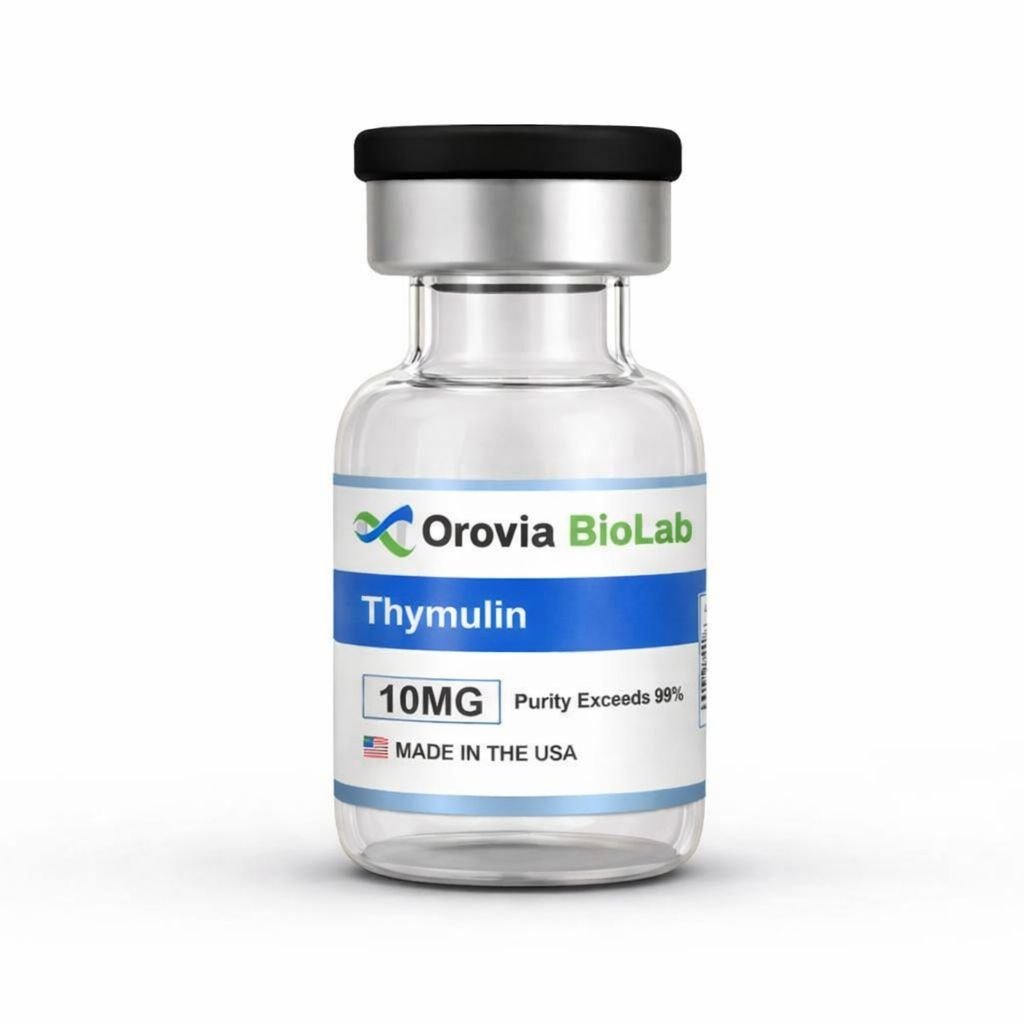
Thymulin (also known as thymic factor or facteur thymique serique) is a naturally occurring nonapeptide hormone produced by the epithelial cells of the thymus gland. It plays a key role in immune regulation, particularly in the differentiation, maturation, and function of T-lymphocytes (T-cells). Its amino acid sequence is: Pyr-Ala-Lys-Ser-Gln-Gly-Gly-Ser-Asn.
Chemical Structure:
Pyr-H-Ala-Lys-Ser-Gln-Gly-Gly-Ser-Asn-OH
- Pyr = Pyroglutamic acid (a cyclized form of glutamic acid).
- Molecular formula: C41H67N15O16.
- Molecular weight: ~858 Da.
Thymulin requires zinc (Zn²⁺) as a cofactor for full biological activity; the zinc-bound form (Zn-thymulin) is the active version.
Biological Functions
- T-Cell Regulation: Promotes the differentiation of thymocytes into mature T-cells and enhances T-cell responses to antigens.
- Cytokine Modulation: Influences production of interleukins (e.g., IL-2) and interferon-gamma (IFN-γ).
- Anti-Inflammatory Effects: Reduces inflammation in autoimmune models and may counteract age-related immune decline (immunosenescence).
- Neuroendocrine Links: Crosses the blood-brain barrier and modulates neuroendocrine functions, potentially affecting pain perception and behavior.
Evidence:
- Discovered in 1977 by Bach et al. (PNAS, 1977).
- Studies show thymulin levels peak in childhood and decline with age, correlating with thymic involution (e.g., Dardenne et al., 1982, Immunology).
Potential Therapeutic Uses
Thymulin and synthetic analogs (e.g., PAT, a stable analog) are researched for:
- Immunodeficiencies: Restoring T-cell function in aging or HIV.
- Autoimmune Diseases: Rheumatoid arthritis, multiple sclerosis (preclinical rodent models show reduced symptoms).
- Cancer Immunotherapy: Enhancing anti-tumor T-cell responses.
- Neuroprotection: Preliminary studies suggest benefits in Alzheimer’s models via anti-inflammatory effects (e.g., Ratnakar et al., 2010).
Clinical Status:
- Not FDA-approved for human use.
- Mostly in preclinical/early clinical stages. Some trials explored subcutaneous thymulin in immunodeficient patients (e.g., 1980s French studies), but no large-scale approvals.
- Available as research peptides from suppliers like Peptide Sciences or Sigma-Aldrich (purity >98%, typically lyophilized powder reconstituted in bacteriostatic water).
Dosing (Research Contexts Only):
| Form |
Typical Research Dose |
Administration |
Notes |
| Synthetic Thymulin |
10-100 mcg/kg |
Subcutaneous |
Zinc-supplemented; short half-life (~minutes). |
| PAT Analog |
1-10 mg/day |
Oral/SubQ |
More stable, longer half-life. |
Side Effects & Safety
- Low Toxicity: Animal studies show minimal adverse effects at physiological doses.
- Potential Risks: Overstimulation of immune response could exacerbate autoimmunity; zinc interactions.
- Contraindications: Avoid in thymoma or active infections without medical supervision.
- Human data limited; consult a physician before use.
Recent Research Highlights
- 2020s Studies: Thymulin analogs show promise in COVID-19 immune dysregulation (e.g., enhancing T-cell exhaustion reversal; Front Immunol, 2021).
- Aging: Restores thymic function in aged mice (J Gerontol, 2018).
- Patents: Several for stabilized analogs (e.g., US Patent 10,000,000+ series).
For sourcing or protocols, refer to PubMed (search “thymulin peptide”) or Examine.com. Always prioritize lab-tested products and professional advice—this is not medical guidance. If you have a specific aspect (e.g., synthesis, studies), let me know!
 Express & Discreet Shippin
 Express & Discreet Shippin




Reviews
Clear filtersThere are no reviews yet.