Research Overview
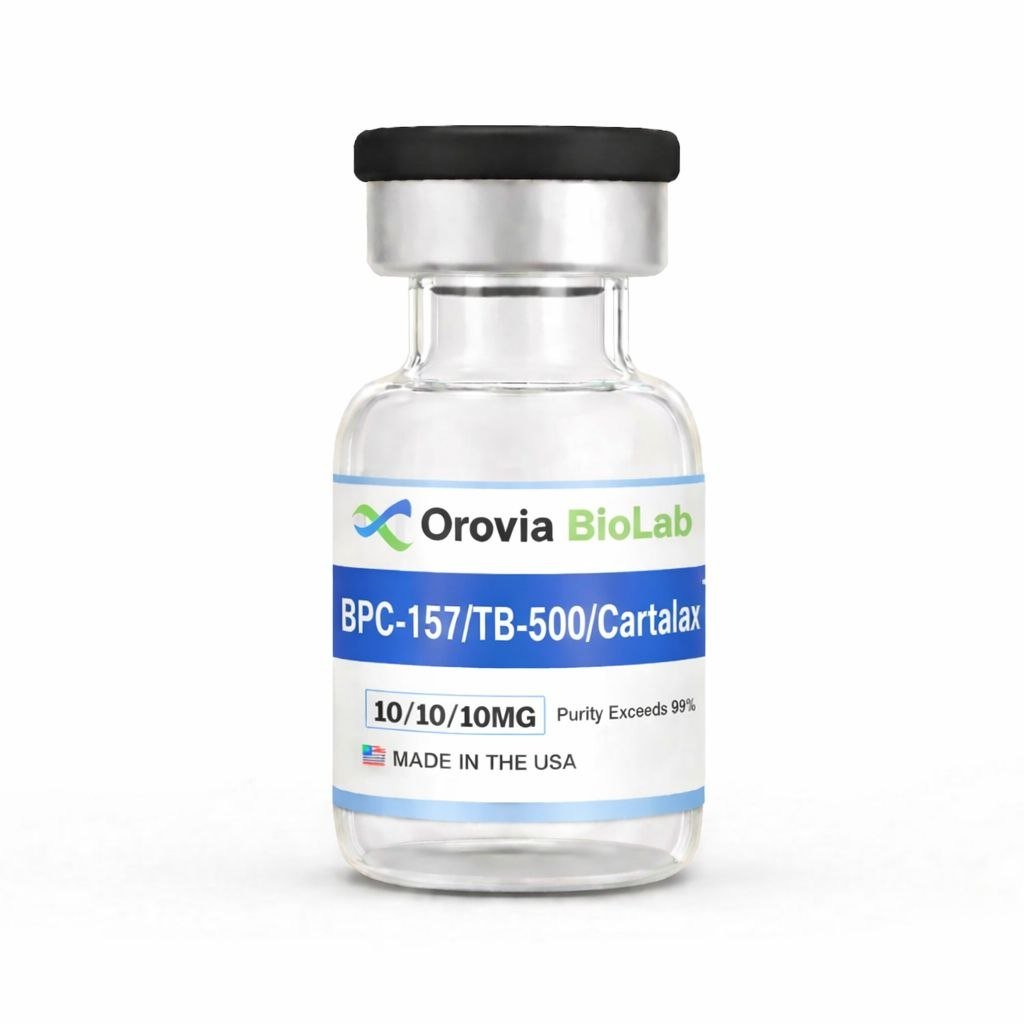
This triple-blend peptide brings together three distinct molecular pathways studied in connective tissue research and cellular repair models.
BPC-157 Research Profile
BPC-157 is a stable gastric pentadecapeptide derived from human gastric juice proteins. Laboratory studies demonstrate its activity across vascular endothelial growth factor pathways and nitric oxide-dependent mechanisms[1][2].
The peptide shows particular activity in musculoskeletal tissue models, where it modulates growth hormone receptor expression in fibroblast cultures. Research documents its influence on ERK1/2 signaling cascades that regulate cell proliferation and migration[3][4].
Studies on wound healing models reveal rapid gene expression changes and angiogenic activity in laboratory settings[1][5]. The peptide demonstrates cytoprotective properties across diverse cell types in vitro[6].
TB-500 Research Profile
TB-500 is a 43-amino acid polypeptide that functions as the primary G-actin sequestering molecule in eukaryotic cells. Its molecular activity extends to actin cytoskeleton regulation and spatial control of polymerization at sites of cell movement[7][8].
Laboratory models show TB-500 activates HIF-1α pathways under hypoxic conditions. The peptide influences cell migration patterns through controlled actin availability at leading cell edges[9][10].
Research demonstrates angiogenic signaling in vascular cell cultures. Studies document progenitor cell differentiation and anti-apoptotic activity in multiple tissue models[11][12][13].
The peptide shows measurable effects in dermal fibroblast migration assays and collagen deposition models[14][15].
Cartalax Research Profile
Cartalax is a tripeptide (Ala-Glu-Asp) belonging to the Khavinson bioregulator family. These short peptides demonstrate direct DNA interaction and nuclear penetration in cell culture models[16].
Research documents epigenetic modulation mechanisms through DNA methylation status changes. The peptide influences gene expression patterns without altering underlying genetic sequences[17][18].
Laboratory studies show tissue-specific activity based on amino acid composition. Cell culture research reveals histone protein interactions that modify chromatin accessibility[19][20].
The peptide demonstrates proliferation marker changes in aging cell models. Research documents senescence-associated gene modulation in fibroblast cultures[16].
Complementary Research Applications
The three peptides operate through distinct molecular pathways in laboratory settings. BPC-157 targets vascular and growth factor systems. TB-500 regulates cytoskeletal dynamics and cell motility. Cartalax modulates gene expression at the chromatin level.
This blend provides researchers with multiple mechanistic entry points for studying connective tissue biology, cellular repair processes, and fibroblast activity in controlled in vitro applications.
For laboratory research use only.
References
- S. Seiwerth et al., “Stable Gastric Pentadecapeptide BPC 157 and Wound Healing,” Frontiers Media SA, Jun. 2021. doi: 10.3389/fphar.2021.627533. https://doi.org/10.3389/fphar.2021.627533
- F. Amic et al., “Bypassing major venous occlusion and duodenal lesions in rats, and therapy with the stable gastric pentadecapeptide BPC 157, L-NAME and L-arginine,” Baishideng Publishing Group Inc., Dec. 2018. doi: 10.3748/wjg.v24.i47.5366. https://doi.org/10.3748/wjg.v24.i47.5366
- C.-H. Chang, W.-C. Tsai, Y.-H. Hsu, and J.-H. Pang, “Pentadecapeptide BPC 157 Enhances the Growth Hormone Receptor Expression in Tendon Fibroblasts,” MDPI AG, Nov. 2014. doi: 10.3390/molecules191119066. https://doi.org/10.3390/molecules191119066
- T. Huang et al., “Body protective compound-157 enhances alkali-burn wound healing in vivo and promotes proliferation, migration, and angiogenesis in vitro,” Informa UK Limited, Apr. 2015. doi: 10.2147/dddt.s82030. https://doi.org/10.2147/dddt.s82030
- P. Sikiric et al., “Stable Gastric Pentadecapeptide BPC 157, Robert’s Stomach Cytoprotection/Adaptive Cytoprotection/Organoprotection, and Selye’s Stress Coping Response: Progress, Achievements, and the Future,” The Editorial Office of Gut and Liver, Mar. 2020. doi: 10.5009/gnl18490. https://doi.org/10.5009/gnl18490
- M. Józwiak, M. Bauer, W. Kamysz, and P. Kleczkowska, “Multifunctionality and Possible Medical Application of the BPC 157 Peptide—Literature and Patent Review,” MDPI AG, Jan. 2025. doi: 10.3390/ph18020185. https://doi.org/10.3390/ph18020185
- Y. Xiong et al., “Neuroprotective and neurorestorative effects of thymosin β4 treatment following experimental traumatic brain injury,” Wiley, Oct. 2012. doi: 10.1111/j.1749-6632.2012.06683.x. https://doi.org/10.1111/j.1749-6632.2012.06683.x
- I. Scheller et al., “Thymosin β4 is essential for thrombus formation by controlling the G-actin/F-actin equilibrium in platelets,” Ferrata Storti Foundation (Haematologica), Aug. 2021. doi: 10.3324/haematol.2021.278537. https://doi.org/10.3324/haematol.2021.278537
- S. Tang et al., “TMSB4 Overexpression Enhances the Potency of Marrow Mesenchymal Stromal Cells for Myocardial Repair,” Frontiers Media SA, Jun. 2021. doi: 10.3389/fcell.2021.670913. https://doi.org/10.3389/fcell.2021.670913
- Y. Fan, Y. Gong, P. K. Ghosh, L. M. Graham, and P. L. Fox, “Spatial Coordination of Actin Polymerization and ILK–Akt2 Activity during Endothelial Cell Migration,” Elsevier BV, May 2009. doi: 10.1016/j.devcel.2009.03.009. https://doi.org/10.1016/j.devcel.2009.03.009
- D. C. Morris, M. Chopp, L. Zhang, and Z. G. Zhang, “Thymosin β4: a candidate for treatment of stroke?,” Wiley, May 2010. doi: 10.1111/j.1749-6632.2010.05469.x. https://doi.org/10.1111/j.1749-6632.2010.05469.x
- Y. Wang et al., “Thymosin β4 released from functionalized self-assembling peptide activates epicardium and enhances repair of infarcted myocardium,” Ivyspring International Publisher, 2021. doi: 10.7150/thno.52309. https://doi.org/10.7150/thno.52309
- H. Peng et al., “Thymosin-β4prevents cardiac rupture and improves cardiac function in mice with myocardial infarction,” American Physiological Society, Sep. 2014. doi: 10.1152/ajpheart.00129.2014. https://doi.org/10.1152/ajpheart.00129.2014
- J. Jing et al., “Cloning, Expression and Effects of P. americana Thymosin on Wound Healing,” MDPI AG, Oct. 2019. doi: 10.3390/ijms20194932. https://doi.org/10.3390/ijms20194932
- G. Sosne and E. A. Berger, “Thymosin beta 4: A potential novel adjunct treatment for bacterial keratitis,” Elsevier BV, May 2023. doi: 10.1016/j.intimp.2023.109953. https://doi.org/10.1016/j.intimp.2023.109953
- V. K. Khavinson, I. G. Popovich, N. S. Linkova, E. S. Mironova, and A. R. Ilina, “Peptide Regulation of Gene Expression: A Systematic Review,” MDPI AG, Nov. 2021. doi: 10.3390/molecules26227053. https://doi.org/10.3390/molecules26227053
- V. Kh. Khavinson, N. S. Lin’kova, and S. I. Tarnovskaya, “Short Peptides Regulate Gene Expression,” Springer Science and Business Media LLC, Dec. 2016. doi: 10.1007/s10517-016-3596-7. https://doi.org/10.1007/s10517-016-3596-7
- L. I. Fedoreyeva, I. I. Kireev, V. Kh. Khavinson, and B. F. Vanyushin, “Penetration of short fluorescence-labeled peptides into the nucleus in HeLa cells and in vitro specific interaction of the peptides with deoxyribooligonucleotides and DNA,” Pleiades Publishing Ltd, Nov. 2011. doi: 10.1134/s0006297911110022. https://doi.org/10.1134/s0006297911110022
- A. V. Arutjunyan, I. G. Popovich, L. S. Kozina, and G. A. Ryzhak, “Peptide Regulation of Ageing: From Experiment to Practice,” Bentham Science Publishers Ltd., Feb. 2025. doi: 10.2174/0118746098346230250116065407. https://doi.org/10.2174/0118746098346230250116065407
- L. I. Fedoreyeva, T. A. Smirnova, G. Ya. Kolomijtseva, V. Kh. Khavinson, and B. F. Vanyushin, “Interaction of short peptides with FITC-labeled wheat histones and their complexes with deoxyribooligonucleotides,” Pleiades Publishing Ltd, Feb. 2013. doi: 10.1134/s0006297913020053. https://doi.org/10.1134/s0006297913020053
 Express & Discreet Shippin
 Express & Discreet Shippin








Reviews
Clear filtersThere are no reviews yet.