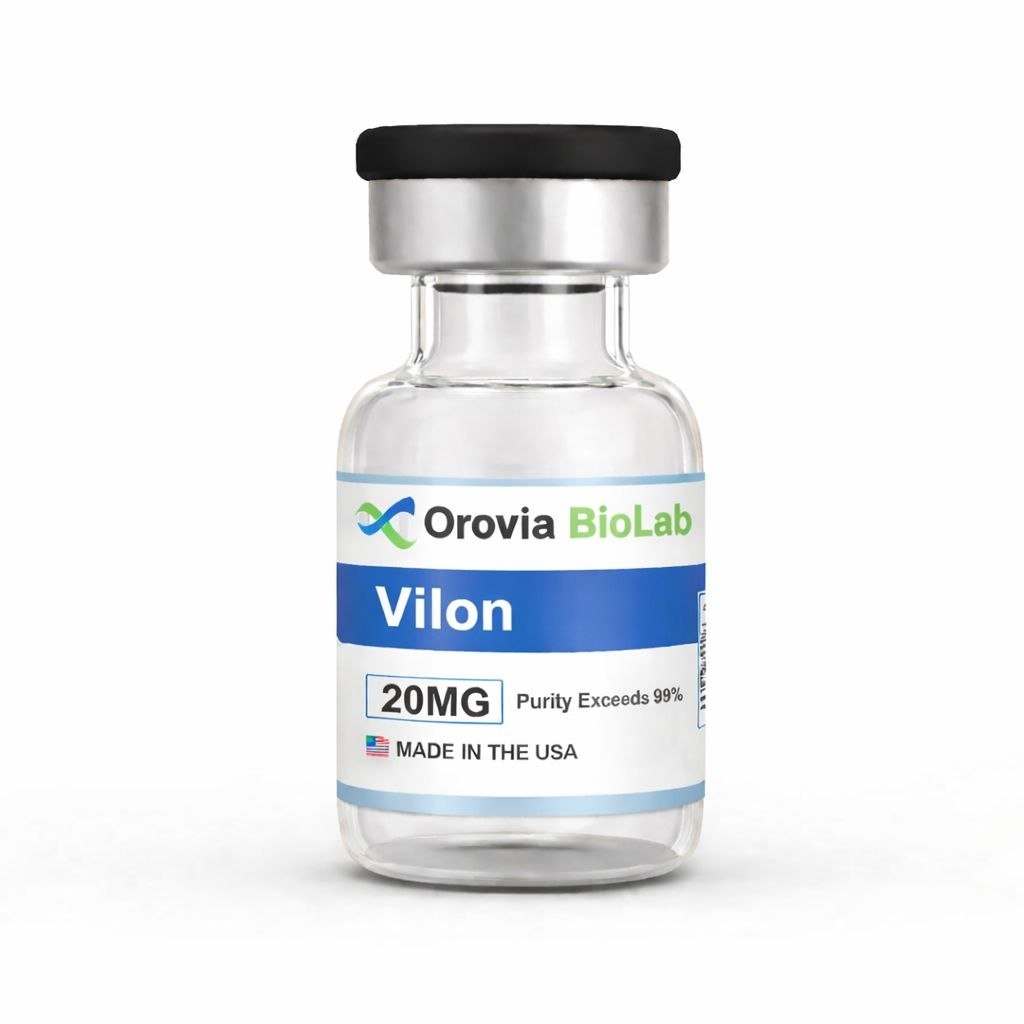
Vilon (also known as Lys-Glu or KE) is a synthetic dipeptide composed of lysine (Lys) and glutamic acid (Glu). It was developed in Russia by the Institute of Gerontology and Experimental Pathology of the USSR Academy of Medical Sciences in the 1990s, primarily as part of research into bioregulatory peptides by scientists like Vladimir Khavinson. Vilon belongs to the class of short-chain peptides designed to mimic natural regulatory signals in the body, targeting gene expression and cellular repair.
Key Properties and Mechanism
- Structure: H-Lys-Glu-OH (a simple two-amino-acid chain).
- Primary Targets:
- Thymus gland (enhances T-cell differentiation and immune function).
- Telomeres (may influence telomerase activity, potentially slowing cellular aging).
- Chromatin (regulates gene activation/suppression for anti-aging effects).
- Mechanism: Acts as an epigenetic regulator. It penetrates cell nuclei, modulating DNA structure and promoting the expression of genes involved in repair, immunity, and longevity. Studies suggest it normalizes chromatin in lymphocytes and restores immune response in aged or stressed organisms.
Potential Benefits (Based on Research)
Vilon has been studied mostly in animal models and limited human trials, often in Russia. Claimed effects include:
| Benefit |
Evidence Summary |
| Anti-Aging |
Increases lifespan in fruit flies, mice, and rats by 10-30% (e.g., Khavinson et al., 2001). Improves biomarkers like telomere length and reduces oxidative stress. |
| Immune Modulation |
Boosts T-cell production; effective in immunodeficient models (e.g., restores thymic function in aged rats). |
| Antioxidant/Anti-Inflammatory |
Reduces lipid peroxidation and inflammation markers in vitro and in vivo. |
| Neuroprotection |
Protects neurons from ischemia; potential in Alzheimer’s models (preclinical). |
| Wound Healing |
Accelerates skin repair in diabetic models. |
Key Studies:
- Khavinson VH et al. (2003) in Bulletin of Experimental Biology and Medicine: Vilon normalized immune parameters in elderly humans.
- Lezhava et al. (2004): Demonstrated telomere elongation in human lymphocytes.
- Over 100 Russian publications; limited Western validation (e.g., PubMed has ~20 English abstracts).
Usage and Dosage
- Forms: Typically administered as subcutaneous injections, nasal sprays, or capsules (e.g., 10-20 mg/day in cycles).
- Common Protocols (from peptide research communities, not FDA-approved):
| Purpose |
Dosage |
Cycle |
| General Anti-Aging |
5-10 mg/day |
10-20 days, 2-3x/year |
| Immune Support |
10-20 mg/day |
10 days |
- Half-Life: Short (~30 minutes), requiring daily dosing.
Safety and Side Effects
- Safety Profile: Low toxicity in studies (LD50 >1g/kg in mice). No major adverse effects reported in human trials up to 20 mg/day.
- Potential Risks: Mild injection-site reactions; theoretical immune overstimulation in autoimmune conditions. Not tested in pregnancy or children.
- Legality: Research chemical in most countries; not approved by FDA/EMA for therapeutic use. Sold online as a nootropic/supplement (e.g., via peptide vendors like CosmicNootropic or Limitless Life).
Limitations and Skepticism
- Most evidence is from Russian studies with small sample sizes and potential bias.
- Lacks large-scale RCTs; mechanisms (e.g., true telomerase activation) need independent confirmation.
- Often bundled with other Khavinson peptides (e.g., Epitalon, Thymalin) in “geroprotector” stacks.
For purchasing or personal use, consult a healthcare provider—peptides like Vilon are experimental. Sources: PubMed, ResearchGate, Khavinson’s publications. If you have a specific aspect (e.g., sourcing, stacking), let me know!
 Express & Discreet Shippin
 Express & Discreet Shippin




Reviews
Clear filtersThere are no reviews yet.